01
Physical location
Not a postcode. The coordinate on the drawing, the floor, the room, the riser. Pinned by the engineer who installed it, on the sheet the building was built from.

Connectors and partnerships
Every manufacturer platform knows a device's serial, model and status. Almost none of them know the coordinate it sits at on a drawing, who installed it, when it was commissioned, or what the client signed off. Graftix does, because an engineer pinned it during first fix.
What we bring
Installation is where device data is created, and it is also where most of it is lost. Graftix sits at that moment, which makes it worth connecting to.
01
Not a postcode. The coordinate on the drawing, the floor, the room, the riser. Pinned by the engineer who installed it, on the sheet the building was built from.
02
Who addressed it, who tested it, what the result was, and the date the client accepted it. Information that currently evaporates the week a job finishes.
03
Serials, models, install dates and warranty start, held in an asset register that outlives the project and feeds the maintenance contract after it.
Where things stand
What is live, what is in development, and what we are looking for.
Live
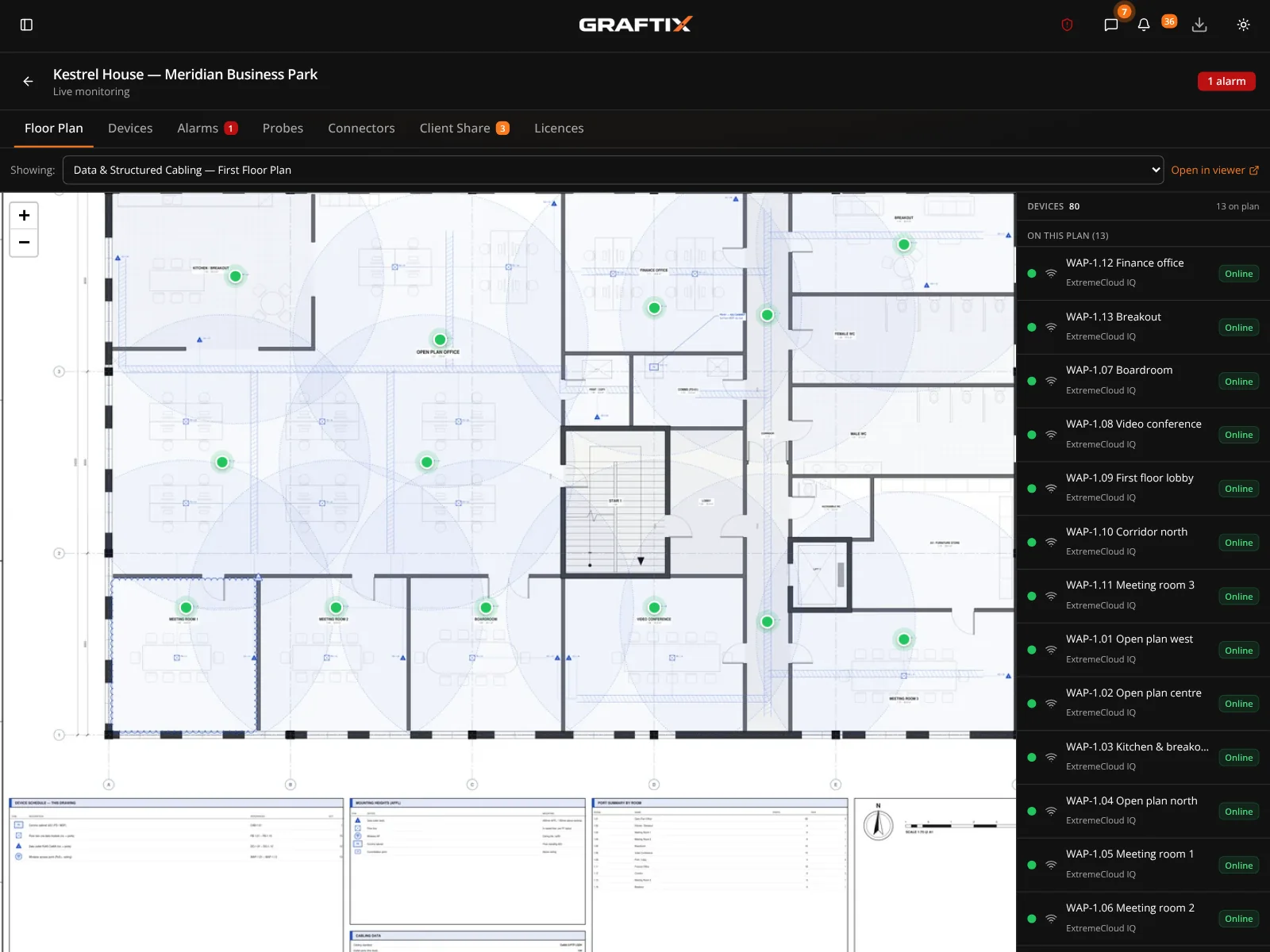
Live. Device status on the drawing, matched to pinned tasks by serial, hostname or MAC; switch and port from LLDP; installation photos synced. Writing hostnames back to the controller is available by arrangement, and every write is logged. Built during a live campus refresh across eighty-plus buildings.
Live
A lightweight on-premises agent for the large proportion of installed kit that has no cloud platform behind it. Runs on Linux x64, ARM64 / Raspberry Pi, Docker, or Windows via Node.js. Outbound HTTPS only, no inbound firewall rules, one probe per VLAN.
Live
87 tools, read plus audited write, for Claude.ai, Claude Desktop, Cursor or any MCP client. Connect with OAuth from Claude.ai, or with a personal token. Graftix Live has its own customer MCP endpoint, so a building manager can connect their own assistant to the sites shared with them.
Live
Invoice export in Xero's import format (CSV), from Operations. It is a file you import, not a live sync.
In development
Panel state surfaced against the devices on the drawing, so a fault has a location rather than just a zone number. This is Graftix Live for the fire trade, and it is the integration we get asked about most.
Wanted
Link test results attached to the outlet they belong to, instead of a bulk export filed at the end of a job and never opened again. Open a task, see the full result. The join is the cable ID the engineer already typed into the tester.
What we are looking for
If you build any of these and the idea of your devices carrying a physical location and a commissioning history is interesting, we would like a conversation.
Network and device platforms
Cloud management for switches, access points and connected hardware, where live status belongs on the drawing.
Access control and intruder
Controller and panel platforms where door and device state should map to a real position in a real building.
Fire detection
Panel manufacturers willing to expose device and fault state, so a fault reads as a location rather than a loop address.
Test and certification equipment
Cable certifiers, electrical test instruments and anything producing structured results that should live on a task.
Product data and specification
Datasheets, symbol libraries and specification data that could populate technical submittals automatically.
Distribution and stock
Live pricing and availability feeding take-off lists, purchase orders and material pools directly.
Warranty registration
We already hold serial, install date and location. Most manufacturers spend real money chasing exactly that and rarely get it.
Business systems
Accounting, payroll and CRM, so project cost and labour stop being re-keyed between systems.
How we build them
Graftix speaks the Model Context Protocol, the open standard Anthropic built for connecting AI assistants and systems to real data. That means an integration does not have to start with someone learning our API, and it means an AI agent can already query a live Graftix project directly.
Where a platform has a REST API we will build to it, as we did with XIQ. Where a manufacturer would rather define a custom workflow, we are happy to start there instead. What we are not going to do is ask you to adopt something proprietary.
Get in touch
If you manufacture, distribute or platform anything that gets installed in a building, there is a conversation worth having. Tell us what you build and what you would want out of it.